
Ojai's Brick Firehouse
by Craig Walker
Originally published on ojaihistory.com, June 9, 2013.
Draws on period reporting from The Ojai newspaper (1936), County Historical Landmark Information, and an account from David Mason.
Cover: Courtesy of the Ventura County Fire Department Historical Archive 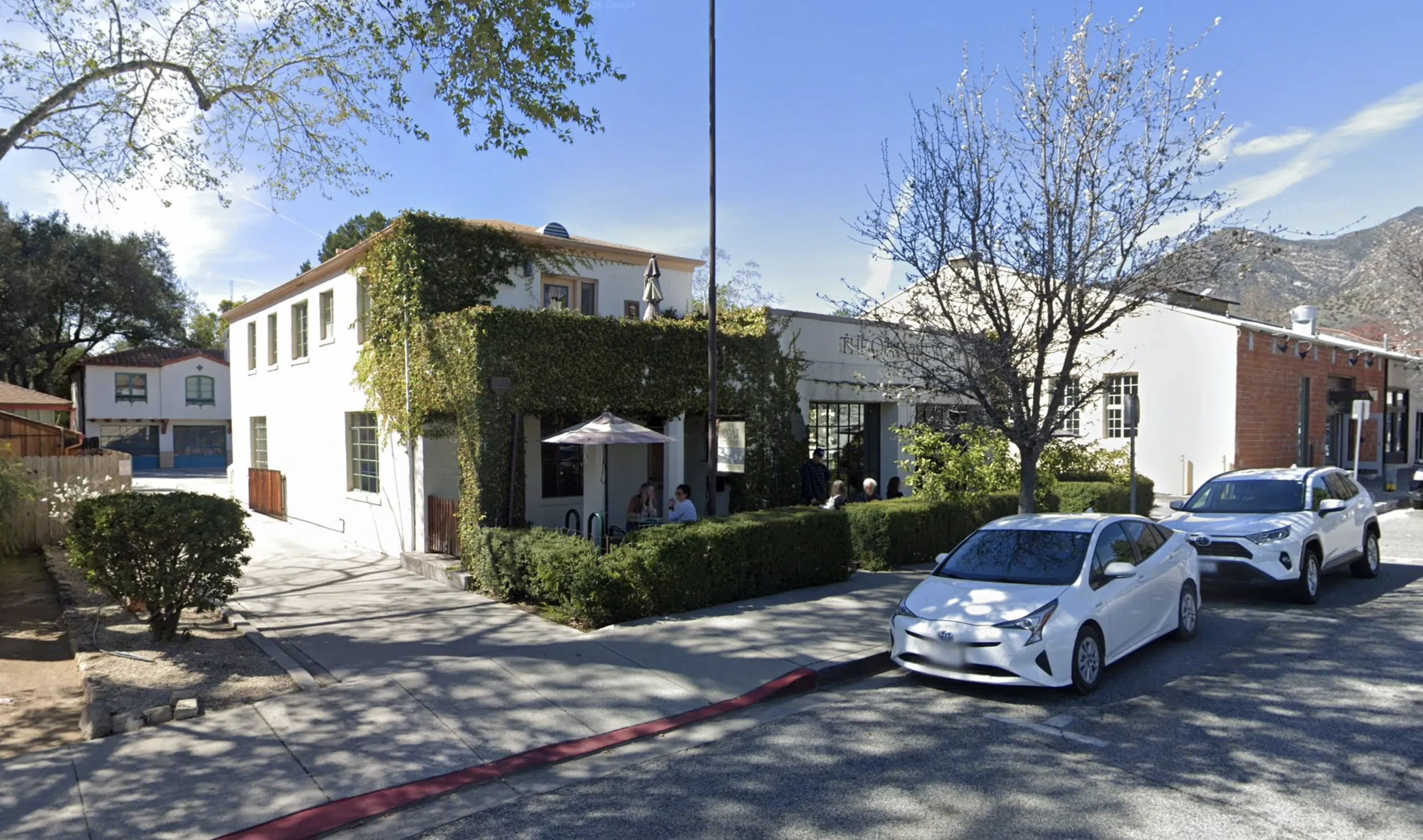
Firehouse as wine tasting room, 2026
Prior to 1929 the Ojai Valley fire protection was left somewhat to chance and the generosity of impromptu volunteers. Of course, the northern borders were watched over by the rangers of the Los Padres Forest. It is to one of the forest rangers who was to become Ojai's first professional fire fighter, William Bowie, that we owe most of the information for this story.
In 1925 the growth of the area outside of Ventura city was such that the county decided to form fire districts for unincorporated areas and invited any incorporated city to join. Ojai voted to do so. Each district had one commissioner. Berkeley Brandt, one of the many easterners who came to Ojai, was the first commissioner. (Berkeley Brandt, also a noted architect, designed the firehouse.) He resided in the East End of the valley, where he was a citrus grower.
In 1925 the volunteer firemen were: Fred Linder, Chief; Lawrence Shaw, Assistant Chief; Art Sacherer, Secretary; Sam Hudiburg, Clarence Lindner, Gene Mitchell, Herb Miller, Tommy Lopez, Guy Cruickshank, Cecil Little, Ken Ayers, Nelson Cota, George Noble, Joe Misbeek, Leon Munger, Bert Griffen, and Stan Bunce. In the forties they were: Martin Kosub, Harold Rice, Guy Stetson Jr., Alvin Kosub, Rudy Lopez, Arla Harris, Henry Lawrence, Jim Gallio, Reg Bunce, Fred Phiffer, and George Schroff.
Volunteer firemen are still used in Ojai (1970s). Even after professional crews took over, the County continued the volunteer concept. Under the plan an individual applies as a volunteer and is required to attend classes in fire suppression. In the old days, when the siren went off, volunteers who were available responded from their businesses and went to the station, where instructions were found on the blackboard. There was no compensation in the beginning for these services. About 1932 the volunteer was paid an hourly rate. This is still the basic program, but they are now contacted by walkie-talkie radio.
Among the early professional firemen were Joe Misbeek, Billy Lonsdale, Frank Keys, and Tommy Lopez. There was also an honorary fire department. Some of the members were Sherman Thacher, W.C. Hendrickson, Hallet Lefferts, L.A. Peasley, Frank Barrington, C.V. Miller, Boyd Gabbert, F.H. Perkins, Ernest Clark, George Sacherer, G.H. Hickey, Carl M. Yant, E.E. Kennison, William Phillips, and Cecil Little.
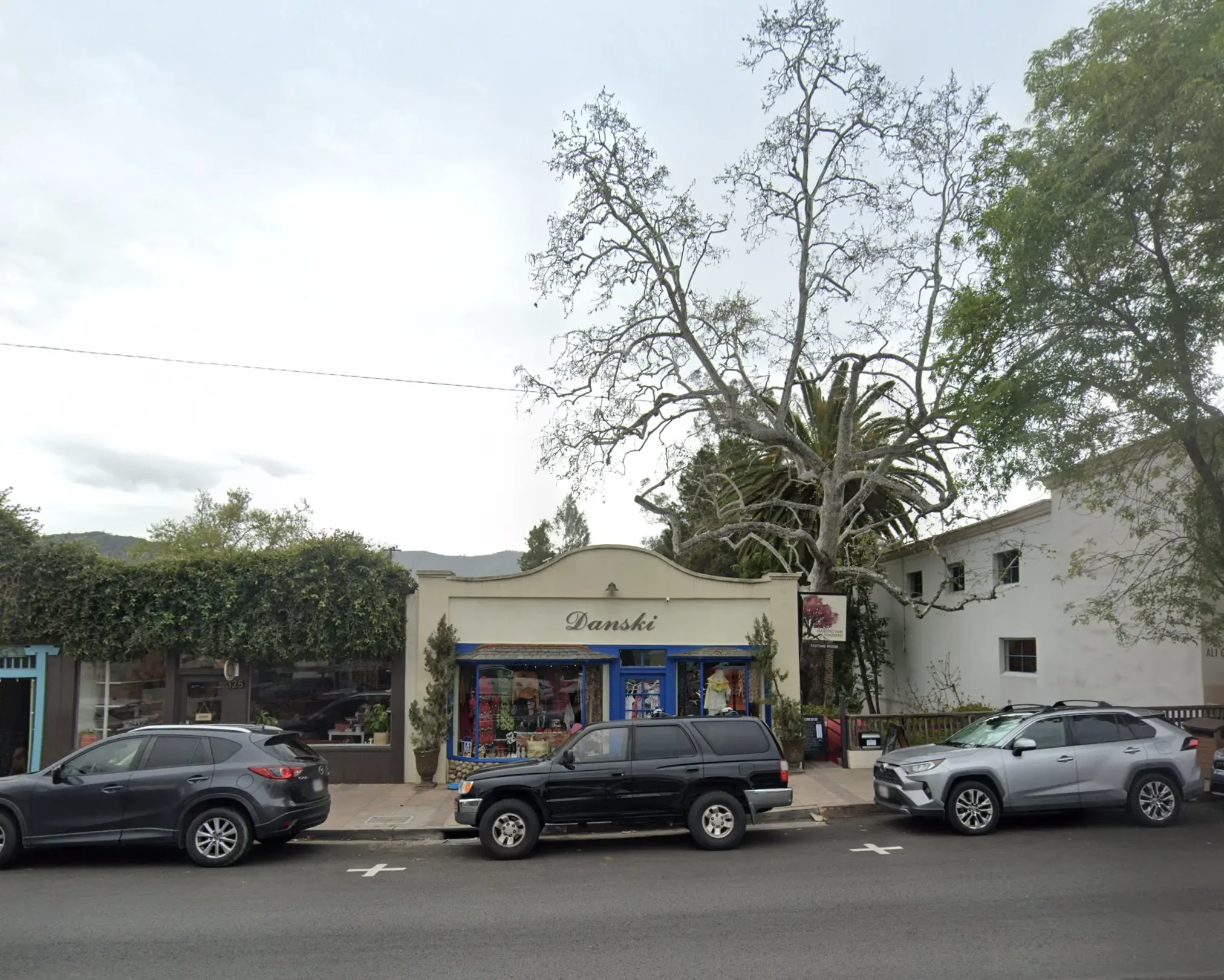
Ojai’s first firehouse was located on Ojai Avenue
The first fire station was on the east bank of Stewart Wash (which now runs under Ojai Avenue just east of the Bank of America). The equipment consisted of a 1917 Model T Ford. Mounted on the car were two twenty-gallon chemical tanks. The Boyd Club occupied the present site of the Bank of America (now a collection of shops on Ojai Avenue). The chief lived on the first floor of the club. He took calls for the police at night. The siren was on the roof of City Hall across Ojai Avenue in the Arcade, mounted on a steel windmill tower.
In July 1926 the volunteer fire department contracted for an American LaFrance fire engine, type 99, with a Buick motor and a one-hundred-gallon booster pump, at a cost of $5,975. When the Ojai Fire District was organized, it assumed $4,000 of the debt. The engine was delivered in December 1928. The truck had a five-hundred-gallon-per-minute pump, a 125-gallon water tank with 500 feet of two-and-a-half-inch hose, and 200 feet of one-inch hose. The down payment was raised by the volunteers and civic leaders, and the fire district paid the balance.
During this expansion period the charter honorary members played an active part: Berkeley Brandt, Hallet Lefferts, W.C. Hendrickson, Frank Barrington, C.V. Miller, Boyd Gabbert, F.H. Perkins, Ernest Clark, George Sacherer, G.H. Hickey, Carl M. Yant, E.E. Kennison, William Phillips, and Philip Pierpont. A bell took the place of a siren and was placed in the belfry of the post office. During the day, the caretaker of the nearby Boyd Center took calls when the chief was out on fire work in the district.
Two Fires
In 1936 the department was credited with helping to fight the Ventura Wharf and Warehouse Company fire. By this time the department had additional equipment in the form of a one-and-a-half-ton Dodge truck with a 300-gallon water tank and hose on the body. The pump was driven by a chain link from a power take-off on the drive shaft.
On October 25, 1939, the fire department was put to the acid test. A fire started in the building housing the Ojai Publishing Company in the Arcade. The entire block was immediately endangered. Very quickly, Fire Warden William Bowie was on the scene with Fire Chief Fred Linder in charge of the volunteers. Equipment from Ventura and Santa Paula was called in. In November of that year the City Council passed a resolution commending Bowie, Linder, and the volunteers for saving the downtown. There were two platoons of volunteer firemen, each of about fifteen men — one on call for downtown Ojai, one for the outlying areas. In the absence of radio communication, one volunteer drove between the two crews during a fire alert to keep each informed. Later, a portable radio system was used that could send messages but not receive them.
Water, Schools, and the War Years
One of the major problems of the pioneer fire department was the numerous water companies with different size pipes, hydrants, and so on. The American States Water Company, which serviced the city, had fire hydrants. The Libbey Water Company supplied the new subdivision, the Arbolada, and the new Country Club. Senior Canyon Water Company supplied the East End. The Ojai Improvement Company piped water from Fox Canyon near Gridley Canyon to the hotel and homes on Foothill Road. Siete Robles Water Company supplied East Ojai Avenue. Meiners Oaks had their own system, as did the Creek Road area. Oak View had two suppliers. None of these had fire hydrants in the early days, and even the American States Water Company's pipes would sometimes break in several places when under stress. When the Libbey Water Company laid a new, larger main from their wells on Grand Avenue to the Arbolada, the fire department laid a connecting line, which greatly improved the downtown situation and reduced fire insurance premiums. Where the capacity of the water lines was in question, hydrants and outlets were painted different colors, with a chart carried on the truck showing which could be used for pumping — a system still necessary today to determine the flow of the system.
As the years advanced, the Fire Department took on fire prevention tasks and ordered safety measures at Nordhoff High, Monica Ros School, Ojai Valley School, and Oak View Elementary. The theater was also inspected and safety measures ordered. An arson unit was also at work, consisting mainly of the chief.
During World War II the Ojai fire department, in cooperation with the Ojai Red Cross and its chairman, Dr. Tippett, taught first aid; 385 citizens participated. During this period the department invested in a resuscitator, inhalator, and aspirator. The resuscitator was donated by the Ojai Valley Woman's Club. Harmon Vaughn, who had purchased the bakery from the Baker family, gave the department a Model A delivery truck, painted red with two white crosses on each side — a sort of ambulance that became part of the department's equipment. The materials for the "ambulance" were again a gift of the Ojai Valley Woman's Club and cost $413. Citizen William Mays donated a portable generator plant at a cost of $150.
All was not serious work for the volunteer fire department. After the tennis tournament concluded on Saturday, the firemen closed off Ojai Avenue between Signal and Montgomery and hosed the area down for a big street dance. Early Sunday morning the firemen were out to wash the powder from the pavement — powder that had been used to help the waltzers glide to the tunes of the '20s and '30s. When Ojai Avenue became a state highway, the practice was discontinued, though even before then town leaders were thinking of ending it because of the intrusion of "outsiders."
Firehouse as gallery, c. 2013
A New Building on Montgomery Street
By 1935 the Ojai Avenue fire station was outgrowing its space. A new site was decided on South Montgomery Street, which had been, since 1894, the former location of the George Thacher Memorial Library. Part of the site was bought by a committee of valley citizens headed by Dr. Charles Butler, destined to become the home of the Ojai Valley Art Center. The space north of that was bought by the fire district and remained the home of the fire department until 1979.
The architect for the new building was, fittingly, Fire Commissioner Berkeley Brandt. According to David Mason, when it was decided to pursue construction of a new building, Brandt volunteered to draw the plans. Originally from Chicago, Brandt had attended the Harvard School, the Chicago Art Institute, and the University of Chicago, and had devoted himself particularly to the study of architecture, later attending the École des Beaux-Arts in Paris. He made a name for himself in America designing large public buildings, mostly libraries and Masonic lodges, including the Ojai Masonic Lodge — work marked by originality and a distinctive individuality that kept his services in constant demand.
The WPA Years
This was the time of the Great Depression, so the fire district applied for federal funds under the Works Progress Administration. The government's share was $6,000, with the Ventura County Fire Department providing an additional $4,000 (the federal government agreed to a 10% override in case of necessity). The district was to furnish the plans and a technician to supervise construction — but the contractor encountered difficulties, and delay set in.
A series of articles appeared in The Ojai under editor Frank Kilbourne. In an editorial on January 9, 1936, he wrote in part: "Oh, yes! there was something said about putting up a new fire hall in Ojai. In fact, the government loan has been secured, the deeds given, the machinery and some material put in place on the lot and nothing happens! Labor shortage, they say! That sounds good. But give us our fire hall as soon as may be — and the cut in insurance rates to follow…"
Kilbourne was answered by a letter to the editor on January 16, 1939, from John A. Dron, local manager for the WPA in Ventura County, who explained that another WPA project in Ojai was absorbing all the eligible and available men on relief: "If The Ojai will point out where twelve carpenters may be found on relief rolls at the present time, anywhere in the County, to put on the fire house, it will perform a great service to the WPA, for there are several projects equally as worthy as this one and now standing approved, which cannot be taken up because of the lack of skilled labor. The primary purpose of the WPA Program is not 'to give a fire hall as soon as may be.'" The Ojai's editor replied in an open letter, regretting any offense and closing with: "it is heartening to know that labor is scarce. And the entire valley is confident that as soon as may be, the fire hall will be built! Meantime, our sincere regrets over the unhappy brain wave which resulted so wrongly."
On January 30, 1936, The Ojai reported that construction had started, with a contractor from Santa Paula and a crew of WPA workmen from Meiners Oaks and Oak View working on the foundation. But by March, the paper reported that only 30 hours of WPA labor per week was available. The same article described the plan: the new building would be constructed of cement blocks, with space for two engines in the large one-story section, and a two-story section with an office, hose room, dormitory, and storage for the fire ladders. Upstairs would be living quarters for the county deputy fire warden in charge — William Bowie and family. The structure would be finished in a white coating of cement and whitewash, giving an effect similar to the high school (now Matilija Junior High School). The Ojai Garden Club, active in those days, secured the cooperation of the county fire authorities in a move to keep telephone poles for the new station's private line off the Santa Paula grade.
When the $8,000 WPA portion was exhausted, the government failed to appropriate the additional $3,000, and the building's interior was threatened with incompletion. According to David Mason, during the final stages of construction the government asked for an accounting and inspection, and found that the construction supervisor had been lax in his duties — often away from the site, spending much of his time gambling in Ojai and Oxnard, and losing much of the firehouse's WPA money in Las Vegas. He had also allowed materials to disappear from the site, and when inspectors arrived, the nearly-finished fire station was little more than a shell, its funds all but depleted. The government refused further help.
Ojai was not to be denied its new firehouse. Ventura County decided to go it alone. A carpenter was hired to build cabinets and install the sinks. The fire warden became the prime mover in completing the project with the help of his staff. It was not until 1939 that a roof went over the small front porch, which became a bedroom.
Moving In
By September 17, 1936, the move into the new building was imminent. The Ojai wrote at the time: "When the new quarters for the Ojai branch of the Ventura County Fire Department on Montgomery Street are completed, the fire boys plan to hold an open house and dance. The public will be invited to inspect the building. The large garage, with overhead doors at both ends, will take care of four cars: the two fire-fighting units now housed in the old firehouse, a light pickup, and Deputy Fire Warden Bill Bowie's personal car. Adjoining the garage is a large office, which will have new desks and equipment, and in the rear a dormitory for additional firemen, with modern showers. The entire upper floor above the offices will be an apartment for Mr. Bowie and his family, with kitchen, bath, bedroom and living room, and with stairs in the front and rear and a passageway leading to the large sun deck above the garage. The grounds in front will be landscaped. A driveway along the south side will lead to a turn-around in the rear, where there will be an area of lawn. A weather box is to be erected here, where an official thermometer, barometer, and other instruments will be located. The whole structure is built of concrete bricks, heavily reinforced with large steel-framed windows throughout, and is a distinct asset to lower Montgomery Street."
No further articles appeared in The Ojai about the opening. A news release of December 17, 1936, notes that the City Council voted to let the Boy Scouts use the old firehouse for a meeting. The move to South Montgomery apparently took place in late 1936 or early 1937.
A Second Life (a note from Ojai Valley Museum)
The fire department remained on South Montgomery Street until 1979, when the county sold the property to the City of Ojai. The Ojai Valley Museum, founded in 1966, moved into the building that year and formally opened there in 1980; it was declared Ventura County Historical Landmark No. 62 that September. The museum moved again in the mid-1990s, after the city purchased and restored the 1919 St. Thomas Aquinas Chapel on West Ojai Avenue — its current home. For a decade and a half, though, the WPA-era brick firehouse this article is about was the Ojai Valley Museum.
State Resources Agency Documentation
For more info: